
Registered Interior Designer Assessment (RIDA)
2024 ARIDO Awards Winner
About RIDA
Competency Areas and Definitions
Description of a Practice Ready Candidate
Eligibility for RIDA
Costs
Passing Standards
Decision Outcomes
Decision Appeals, Retakes and Supporting Policies
About RIDA
The launch of ARIDO’s Registered Interior Designer Assessment (RIDA) field testing was approved by the executive committee on April 14, 2025. The field testing is being conducted in cohorts per the following schedule:
Cohort 1
• Part 1: Practice readiness program commences on June 2, 2025
• Part 2: Interviews scheduled for September 2025
Cohort 2
• Part 1: Practice readiness program commences on October 1, 2025
• Part 2: Interviews scheduled for January 2026
Cohort 3
• Part 1: Practice readiness program commences on February 2, 2026
• Part 2: Interviews scheduled for May 2026
RIDA provides an alternative to meeting ARIDO’s examination requirement for registration in Ontario. The Practice Readiness Program and Entrance Interview ensures that all individuals applying to become a Registered Interior Designer in Ontario are provided a fair and equitable opportunity to demonstrate the competencies required to practice interior design while protecting the public interest. ARIDO recognizes its accountability as a Regulatory Body to advance equity and diverse representation through actionable initiatives.
The two-part assessment process focuses on practical application and advanced analysis & problem-solving across eight (8) competency areas of interior design practice
- Part 1: Practice Readiness Program (30 contact hours flexible online program with self-paced learning)
An online learning program covering key competency areas essential for successful practice. It is self-paced and aligns with ARIDO’s eight competency areas addressing relevant practice aspects. Candidates will also have the opportunity to develop a practice plan during this section of the assessment. - Part 2: Entrance Interview (45-minute oral test conducted virtually by one Chair and 2 Assessors)
A semi-structured oral assessment conducted by a Chair and two assessors. It evaluates the candidate’s ability to apply advanced analysis, problem-solving, and practical skills across ARIDO’s eight competency areas of interior design practice.
Competency areas are weighted to reflect their relative importance in assessing overall practice readiness.
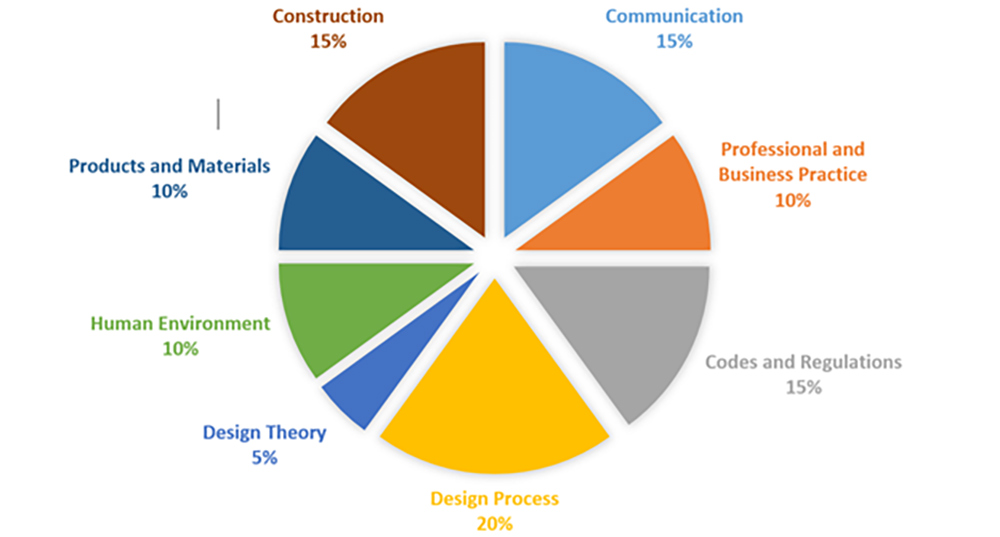

Competency Areas and Definitions
| COMPETENCY AREA | DEFINITION | EXPLANATION |
|---|---|---|
| Communication | Ability to understand, define, and exchange information using a combination of visual, written, and verbal design methods, techniques and tools. | Gather client information visually, verbally and/or in writing. Manage information effectively, for a range of purposes and audiences, to reach agreement and present a design solution. |
| Professional and Business Practice | Ability to understand, communicate, and demonstrate ethical and fair business practices. | Act with integrity and in the best interest of the client and the profession by using sound judgement and accountability in applying fair business practices. |
| Codes and Regulations | Ability to understand, analyze, and apply relevant local codes and standards that protect the health, safety, and well-being of building occupants. | Research and apply relevant local codes, environmental requirements, laws, standards, and regulations. |
| Design Process | Ability to analyze and synthesize programmatic information to develop effective design solutions. | Create, integrate and prepare designs and specifications for implementation of the design solution. |
| Design Theory | Ability to apply an understanding of design history, precedent, and research. | Apply the principles and elements of design, design theories, and historical precedents to a design solution. |
| Human Environment | Ability to understand and integrate the principles of human behaviour and perception into the design solution. | Apply principles of comfort and well-being of occupants that supports the relationships between human needs, function, and the built environment. |
| Products and Materials | Ability to understand, analyze, and specify products and materials to meet the performance requirements and criteria of the design solution. | Apply knowledge of the various properties and qualities of products and materials to form part of the design solution. |
| Construction | Ability to apply knowledge of construction and building systems to administer the design solution. | Apply knowledge of the interrelationship of building systems within interior construction. Utilize contract documents to coordinate and convey design for budget, permit, and construction & administration to clients and other professionals. |
Description of a Practice Ready Candidate
A practice-ready candidate demonstrates the necessary knowledge, skills, and abilities to practice interior design without supervision while protecting the public. This is demonstrated through their submitted work, interview responses, and practice plan, ensuring they meet the required minimum level of competency in all areas. While performance may vary in specific tasks, their overall body of work confirms their readiness for practice as a Registered Interior Designer. A practice-ready candidate demonstrates:
- Proficiency in all competency areas, with particular emphasis on:
- Communication: Ability to understand, define, and exchange information using a combination of visual, written, and verbal design methods, techniques and tools.
- Competency 1.2 – Knowledge of standard documents.
- Competency 1.3 – Skill in visual, written, and verbal communication.
- Professional and Business Practice: Ability to understand, communicate, and demonstrate ethical and fair business practices.
- Competency 2.1 – Knowledge of fair business practices (e.g., conflict of interest, confidentiality, copyright/intellectual property, informed consent, disclosure).
- Codes and Regulations: Ability to understand, analyze, and apply relevant local codes and standards that protect the health, safety, and well-being of building occupants.
- Competency 3.1 – Knowledge of code requirements, laws, standards, and regulations.
- Competency 3.2 – Skill in interpreting and applying code and regulations.
- Design Process: Ability to analyze and synthesize programmatic information to develop effective design solutions.
- Competency 4.2 – Skill in analyzing and synthesizing the programmatic information.
- Competency 4.3 – Skill in developing a design concept.
- Competency 4.4 – Skill in space planning.
- Competency 4.5 – Skill in drafting and technical drawing conventions.
- Design Theory: Ability to apply an understanding of design history, precedent, and research.
- Human Environment: Ability to understand and integrate the principles of human behaviour and perception into the design solution.
- Competency 6.3 – Knowledge of universal design principles (e.g., equitable use, low physical effort).
- Products and Materials: Ability to understand, analyze, and specify products and materials to meet the performance requirements and criteria of the design solution.
- Competency 7.2 – Skill in selecting products and materials to meet specific criteria (e.g., budget, quality, ergonomics, performance, environmental impact, longevity).
- Construction: Ability to apply knowledge of construction and building systems to administer the design solution.
- Competency 8.2 – Knowledge of construction drawings as contract documents.
- Competency 8.3 – Knowledge of detailing and specifications of materials, products, and finishes (e.g., millwork).
- Communication: Ability to understand, define, and exchange information using a combination of visual, written, and verbal design methods, techniques and tools.
Essential Qualities
Integration: Demonstrates the ability to integrate competencies across all areas, recognizing their interdependencies and seeking additional support when needed.
Professionalism: Demonstrates professionalism and ethical conduct, with a commitment to continuous professional development.
Public Protection: Prioritizes public safety and well-being, adhering to legal and ethical guidelines and taking proactive steps to mitigate risks.
Eligibility for RIDA
General Eligibility
Candidates must complete both the education and experience requirements to be eligible for the RIDA assessment.
Practice Readiness Program (Part 1)
- Meet ARIDO’s Education Requirements (CIDA-accredited degree or Intern Competency Review System – ICRS)
- Meet ARIDO’s supervised work experience requirements (IDER or grandfathered hours-based)
- Complete the RIDA Application Form
- Pay the assessment fee for Part 1 and enrollment fee (for non-ARIDO members) by the applicable deadline
Entrance Interview (Part 2)
- Complete Part 1 by the due date
- Submit a Practice Plan
- Pay the assessment fee for Part 2 by the applicable deadline
The Process
- Candidate applies to the Practice Readiness Program
- Staff provide login details for the online learning platform
- Candidate completes modules at their own pace
- Candidate requests an Entrance Interview after completing all modules
- Process Coordinator schedules the interview and shares format details
- Interview includes:
- 30 minutes of competency-based questions
- 15 minutes to present and discuss the Practice Plan
- Assessors deliberate for 45–60 minutes; decision requires agreement from at least two Assessors
- If no agreement, Chair casts the deciding vote
- Registrar issues a Decision Report via email within 2 business days
- Candidate receives formal written notice of the decision
Costs
Total Cost: $965 + HST (Assessment Fee) + $75 + HST (Enrollment Fee*)
Payment Options: Two installments — at the beginning of Part 1 and before the Entrance Interview. Due dates are set by the Registrar.
Additional Fees
- Follow-Up Entrance Interview: $480 (for “Partially Ready” candidates)
- Re-Enrolment: $965 + $75 enrollment fee (for “Not Ready” candidates)
*Enrollment fee applies only to non-members and members of other provincial bodies.
Passing Standards
Part 1: Practice Readiness Program
- Complete all content modules
- Score at least 80% on all quizzes
- Submit all assignments as instructed
- Submit a detailed Practice Plan using the provided template
Part 2: Entrance Interview
- Participate in a 45-minute panel interview (Chair + 2 Assessors)
- Answer competency-based questions (30 minutes)
- Present and discuss Practice Plan (15 minutes)
- Receive “practice-ready” ratings in all 8 competency areas from at least two Assessors
If Assessors disagree, the Chair’s rating will be the deciding factor.
Decision Outcomes
Ready
Candidate meets competency in all 8 areas and is eligible to apply for registration.
Partially Ready
- Competency met in at least 6 of 8 areas
- Must address gaps before reapplying
- Provided with an action plan template
- Can apply for a follow-up Entrance Interview
Not Ready
- Competency met in 5 or fewer areas
- Must address significant gaps before re-taking the program
- Provided with an action plan template
- Can apply to re-enrol in the program and Entrance Interview
Decision Appeals, Retakes and Supporting Policies
Decision Appeals
If a candidate receives a decision of “Partially Ready” or “Not Ready” from the Entrance Interview, they may appeal the decision.
Appeal Process:
- Submit a written appeal to the Registrar within 15 business days of receiving the decision.
- Clearly state the grounds for appeal and provide supporting evidence.
Grounds for appeal include:
- Procedural irregularities during the assessment
- Bias, conflict of interest, or technical issues during the interview
- Errors in judgment or misinterpretation of assessment criteria
- Discrimination based on protected characteristics (e.g., race, gender, religion)
An independent Appeals Committee will review the appeal and provide a final decision within 10 business days.
Re-takes
Candidates who receive a “Partially Ready” or “Not Ready” decision may re-take the Practice Readiness Program and reapply for the Entrance Interview after addressing identified competency gaps.
Accommodations
Candidates requiring accommodations may submit a written request to the Registrar at least 40 business days before the scheduled interview date.
Key Steps:
- Request Submission: Describe the accommodation needed and include supporting documentation.
- Review Process: Registrar will respond within 20 business days.
- Implementation: Approved accommodations will be applied to the program/interview.
All requests are handled confidentially. ARIDO is committed to ensuring equal access and opportunity for all candidates.
Recusal
Assessors must disclose any personal or professional relationships with candidates before reviewing materials. If a conflict is identified, the Assessor will step aside to ensure impartiality.
This policy maintains the integrity and fairness of the assessment process.
EDI & Bias Training
All Assessors are required to complete ongoing EDI and bias training, including modules on:
- EDI principles
- Unconscious bias
- Equitable assessment practices
Assessors also participate in regular discussions and renew their commitment annually to uphold fairness and inclusion.


